
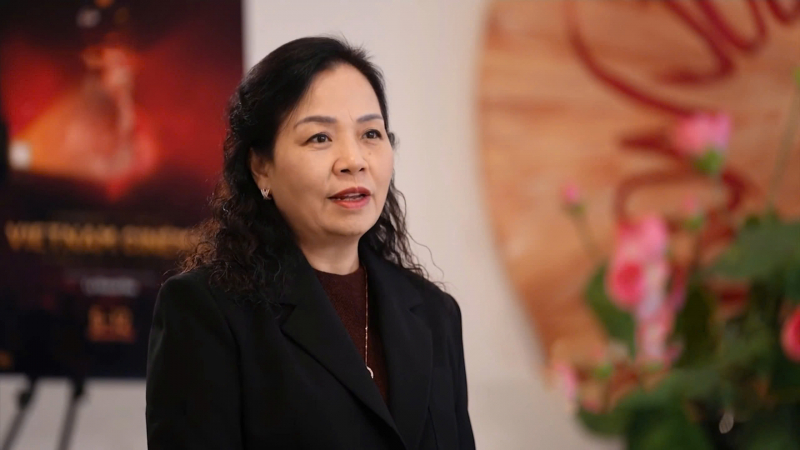
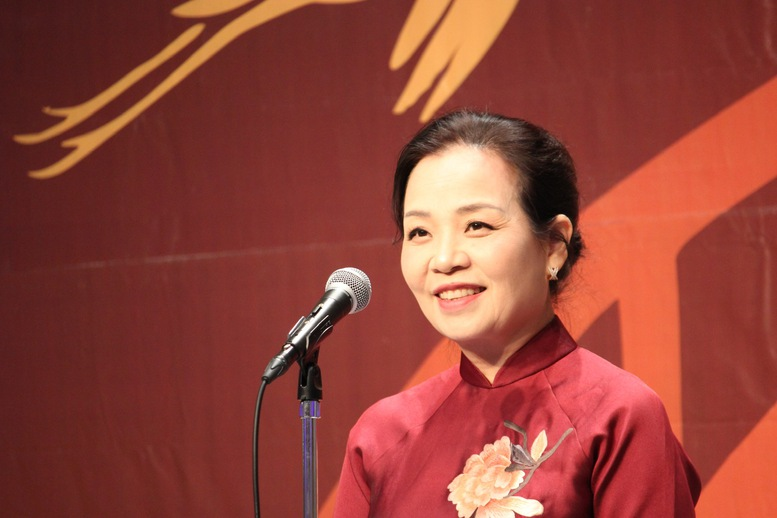
PhD. Ngo Phuong Lan, Deputy Head of the Literature and Arts Theory Criticism Subcommittee - Central Theory Council, Chairwoman of the Vietnam Film Development Association
For the first time, culture is placed in a close relationship with the economy and the market
From the perspective of a policymaker and someone who has long been engaged in cultural work - particularly in cinema - could you assess the key values, core elements, and new aspects of Resolution No. 80-NQ/TW?
PhD. Ngo Phuong Lan: Resolution No. 80-NQ/TW of the Politburo on cultural development is a decision of particular significance in the current context. The Resolution continues to affirm culture as the spiritual foundation of society, while emphasizing its role as an endogenous resource and a crucial driving force for the country’s sustainable development.
What is especially important is that the Resolution situates cultural development within the context of international integration - specifically, proactive integration. This is also the direction and approach that I, as well as the Vietnam Film Development Association, have been striving to pursue. Without proactivity, it would be impossible to seize opportunities for cooperation, to persuasively introduce Vietnam, its people in general, and Vietnamese cinema in particular, to the world, and to bring the essence of global culture and cinema to Vietnamese audiences.
In the context of deep international integration and increasingly intense competition in terms of values, identity, and soft power, especially with the rapid development of artificial intelligence, having an idea requires swift implementation. Therefore, proactivity is of critical importance. Resolution No. 80-NQ/TW reflects the Communist Party of Vietnam’s strategic, long-term, and timely vision for the revitalization and development of Vietnamese culture.
One particularly noteworthy new aspect of Resolution No. 80-NQ/TW is its comprehensive and modern approach to cultural development. For the first time, culture is placed in a close relationship with the economy, the market, and cultural industries, recognizing cultural products as a development resource and a vital component of national “soft power”.
When discussing the cultural sector and cultural industries, including cinema, it is essential to address the market. Without a market, it is impossible to build a cultural industry.
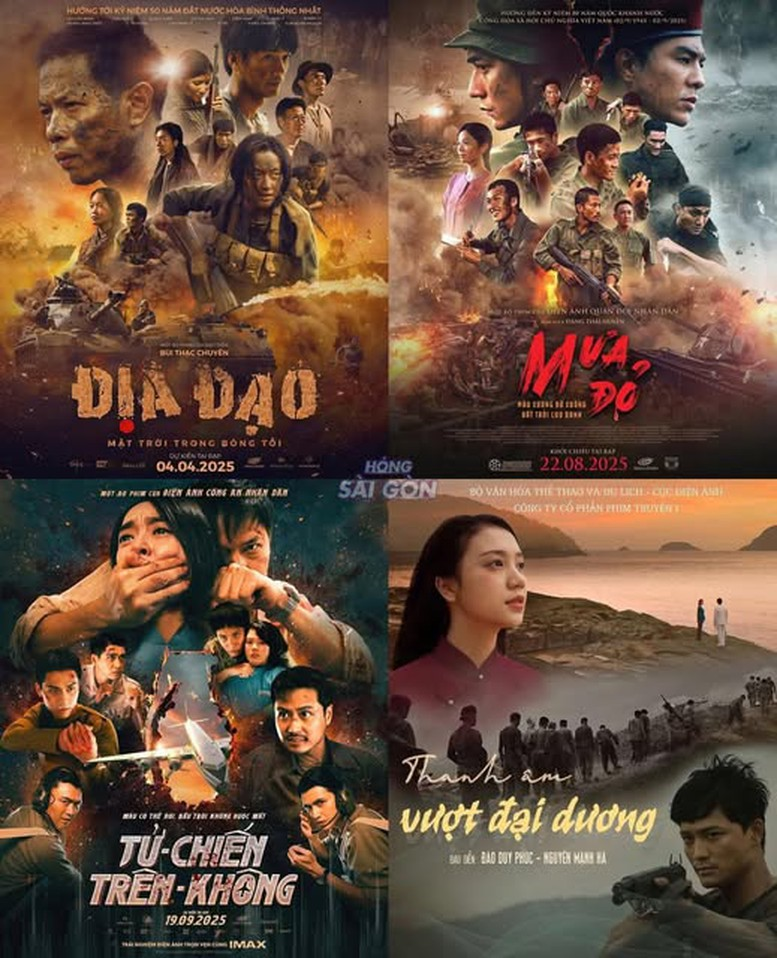
In recent years and in 2025, the growth of the domestic film market has created excitement and affirmed the endogenous strength of Vietnamese cinema.
In the field of cinema, this relationship is clearly evident. Vietnam’s film market is currently developing at a very rapid pace. In recent years, particularly in 2025, the growth of domestic films’ market share has generated strong public enthusiasm and demonstrated the endogenous strength of Vietnamese cinema.
Notably, in the past year, films on war themes set records for the highest box-office revenues in the history of Vietnamese cinema. This reality shows that cultural products are indeed a development resource and an important component of national soft power.
At the same time, it should be noted that 2025 was a year marked by many special events and major national anniversaries. As a result, films with traditional and war-related themes were received with exceptional enthusiasm by audiences. Films such as Red Rain, Tunnels, and Hijacked created a strong impact and achieved significant box-office success.
Encouragingly, in 2025, Vietnam’s film market recorded strong growth-up 27%, while many film markets in the region had yet to fully recover to pre-COVID-19 levels.
Resolution No. 80-NQ/TW also emphasizes the role of institutions, policies, resources for cultural development, and science and technology, laying the groundwork for removing long-standing “bottlenecks” in this field.
However, to develop culture and link it with cultural industries and the market, appropriate public-private cooperation mechanisms are essential, in line with the principles of sustainable development. Currently, public-private cooperation remains a significant bottleneck in cultural development, most visibly in the film sector, particularly in cooperation between distributors, cinemas, and film producers.
In summary, Resolution No. 80-NQ/TW represents a breakthrough by opening a coherent policy corridor for cultural development aligned with the market and international integration. When culture is recognized as a field capable of generating economic value, creative stakeholders gain greater motivation and conditions to invest, innovate, and pursue sustainable development. Notably, the Resolution provides a foundation for promoting socialization, attracting non-state resources, and strengthening public-private cooperation in the cultural sector, thereby enhancing investment efficiency and the competitiveness of Vietnamese cultural products.
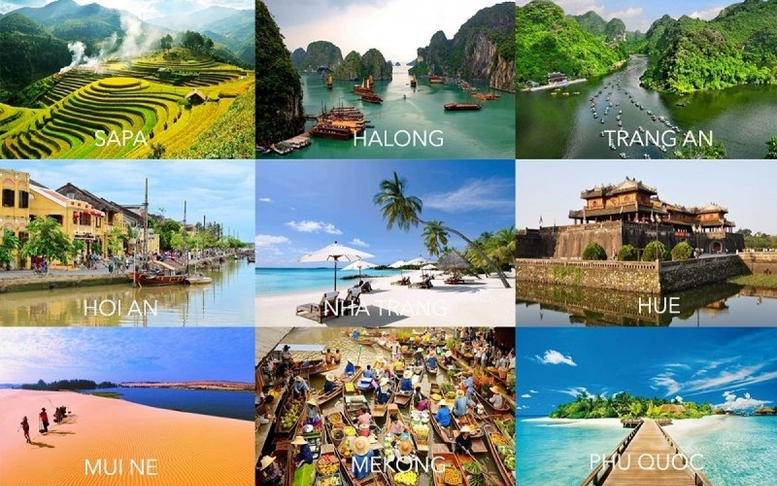
Developing cultural industries and national brands associated with tourism is a correct direction and consistent with the general development trend of the world.
One of the key tasks outlined in the Resolution is to promote the development of cultural industries and cultural markets, and to position cultural products as national brands linked to cultural tourism. How do you assess this orientation?
PhD. Ngô Phương Lan: Developing cultural industries and national branding in connection with tourism is a highly appropriate direction, consistent with global development trends. Cultural industries, including cinema, not only generate economic value but also contribute to promoting the image of the country, its people, and Vietnamese cultural identity internationally.
When cultural products are linked with cultural tourism and national branding, new value chains are formed, creating unique experiences for visitors while enhancing Vietnam’s position and attractiveness on the global cultural-tourism map.
In recent years, the Vietnam Film Development Association appears to have followed a path aligned with the Resolution’s orientation - particularly in 2025, with film promotion activities abroad in the United States (Los Angeles, Washington D.C., New York, and Boston), South Korea (Busan International Film Festival), Japan (Tokyo International Film Festival), and France (Cannes Film Festival and the Vietnam Film Week “The Journey of Light”).
Through these activities, we have contributed to presenting Vietnam’s image, introducing filming environments and Vietnamese films to the world, and attracting filmmakers and international partners to Vietnam.
Notably, the working mission in the United States laid the groundwork for organizing “Focus on American Cinema” at the Da Nang Asian Film Festival for the fourth time in 2026. This program not only introduces American cinema beyond mainstream Hollywood films, but also presents the historical development of world cinema. American cinema serves as a “mirror” of global cinema, evolving powerfully from the silent film era, leaving its mark through each decade of the 20th century to the present day.
Within the Da Nang Asian Film Festival, we have organized and will continue to organize workshops such as “Talent Incubator” and “Workshop & Project Market”, aimed at discovering young talents and inviting reputable international experts to Vietnam to exchange knowledge and provide training for emerging filmmakers.
People and institutions as decisive factors
In your view, what are the decisive factors for effectively implementing Resolution No. 80-NQ/TW in practice?
PhD. Ngô Phương Lan: I am very pleased that Resolution No. 80-NQ/TW sets out highly specific objectives and solutions. For the Resolution to truly take effect, the decisive factors are people and institutions. It is essential to have a contingent of cultural managers with innovative thinking, strong practical understanding, and sufficient capacity to implement policies.
At the same time, the Resolution must be promptly translated into concrete, feasible programs and action plans, with priority given to completing the legal framework for cultural industries and investing in the development of high-quality creative human resources.
The specific objectives and solutions outlined in the Resolution will have a significant impact on cultural activities, particularly for professional social organizations such as the Vietnam Film Development Association. In recent years, the Association has operated with great dedication and passion for the profession, developing programs, events, and effective cooperation initiatives that contribute to building the brand of Vietnamese cinema.
A clear example is the organization of the Da Nang Asian Film Festival (DANAFF). Building an international film festival brand requires stability and sustained development, and over the past three years, DANAFF has achieved this. Although still relatively new, DANAFF has established itself as a highly professional platform and has increasingly affirmed its credibility. For a professional social organization to independently organize an international-scale film festival over three successful editions, attracting major film industries from around the world, is a challenging journey marked by considerable effort and perseverance.
In the coming period, the Vietnam Film Development Association will continue to strengthen international promotion and cooperation activities, bringing Vietnamese cinema closer to the world while introducing world cinema to domestic audiences.
The Association will also actively contribute to policy development, identify and support the growth of creative human resources, and enhance the quality of cinematic activities, with the goal of building Vietnamese cinema into a competitive cultural industry that effectively contributes to socio-economic development and national image promotion.
(Diệp Anh - baochinhphu.vn)